Understand your child’s behaviour, then plan useful support
Hitting, screaming, refusal or constant movement can have different explanations. Start with the child’s needs, strengths and situation, then choose a practical next step.
What can contribute to behavioural difficulties?
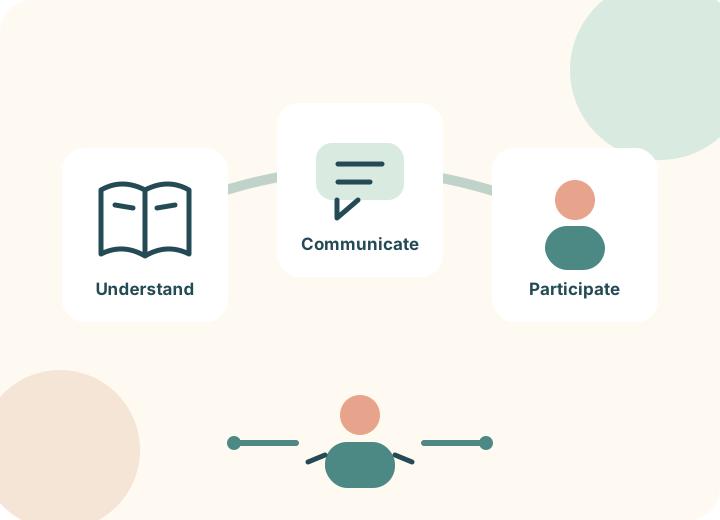
Behaviour happens in context. A child may struggle to communicate “help”, “stop” or “I need a break”. Noise, touch, crowds, unfamiliar routines or an abrupt transition may be overwhelming. A task can also require language, learning or motor skills that the child has not yet mastered.
Feelings matter too: worry, sadness, frustration or a frightening experience can affect participation. Pain, constipation, hunger, fatigue, illness, medication effects and poor sleep may contribute to a change. Expectations and the responses that follow an action can influence patterns over time, but they should not be treated as the only explanation.
These are possibilities to explore, not assumptions about your child. Notice what happens before and afterwards, what the child communicates and which situations go well. Read about sudden behaviour changes and health concerns or understanding patterns in ABC records.
Behaviour is not a diagnosis
Concerns may occur alongside autism, ADHD, intellectual disability, learning difficulties, communication differences or anxiety. Low mood, trauma-related difficulties and health problems may also need consideration. ODD requires an appropriate assessment; ordinary refusal alone does not establish it.
Some children have several contributing needs, and some do not meet criteria for a disorder. Support should address what is making life difficult rather than use a label as the whole explanation.
Common situations and existing resources
These guides and printables already cover many concerns in depth. Choose the one that fits the situation you have noticed.
- Preparing observations for a behaviour consultation
- A school support plan for emotional dysregulation
- Hitting, biting and aggression
- Responding to tantrums
- Tantrums and meltdowns
- Meltdowns and shutdowns
- Not following instructions: understanding and attention
- Transitions between activities
- Rigid routines and change
- Parent training for children with ADHD
- ADHD and emotional regulation
- ADHD, friendships and turn-taking
- Sensory differences and participation
- Teaching requests: help, break and finished
- Communication beyond speech
- Discipline without hitting or shouting
- Everyday behaviour home programme
- Support for big feelings
- Printable ABC behaviour chart
- First–then visual support
- Printable token board
- Printable reward chart
- Printable goal tracker
- ODD: assessment and support questions
- Understanding child behaviour programmes
For emotional regulation and anger, also explore child emotional-regulation support. For sharing, turn-taking and peer relationships, see social-skills support.
Assessment, plans and progress
Understanding behaviour: assessment, planning and review
Learn how observations, developmental and health information, a written support plan and regular reviews fit together when a child needs behaviour support.
Read the guide →Functional behaviour assessment: questions for parents
Understand what a functional behaviour assessment explores, how parents can prepare, and why an ABC diary alone cannot establish the cause of a child’s behaviour.
Read the guide →A child behaviour action plan: what to include
See what belongs in an individual child behaviour action plan: a clear goal, prevention, replacement skills, safe responses, responsibilities and review dates.
Read the guide →Understanding ABC behaviour records: patterns and limits
Explore patterns in completed ABC behaviour records, compare similar situations and discuss uncertainty without treating a diary as proof of a child’s motives.
Read the guide →Reviewing a child’s behaviour plan: what counts as progress?
Review communication, participation, distress and practical burden alongside incident counts. Learn what to bring to a review and when a plan needs changing.
Read the guide →Understand a specific situation
When a child refuses work: look at the task and the support
Explore why a child avoids work or routines, how to make tasks more manageable, and when learning, language, anxiety or health needs deserve assessment.
Read the guide →When a child throws objects: safety, context and alternatives
Understand repeated throwing in children, protect people nearby and explore safer ways to play, communicate or leave an overwhelming activity.
Read the guide →Frequent screaming in children: understand the message
Explore frequent screaming without assuming defiance. Consider communication, discomfort, overwhelm and the setting, then plan a calmer way to ask for help.
Read the guide →Good at school, distressed at home: understanding the pattern
Consider tiredness, stress, sensory demands and different expectations when a child manages school but becomes distressed at home. Plan support without blame.
Read the guide →Sudden behaviour change: when to consider health and stress
A sudden change in a child’s behaviour may need a health or wellbeing review. Learn what to notice, what to record and when not to wait for a behaviour plan.
Read the guide →Support across home and school
Positive reinforcement: encourage skills without pressure
Learn how to choose a manageable skill, notice progress and use meaningful encouragement without withholding essential needs or demanding perfect behaviour.
Read the guide →When carers respond differently: agree a workable plan
Help parents, grandparents and other carers agree clear, compassionate responses while allowing for different settings and the child’s changing needs.
Read the guide →School and home behaviour support: build a useful handover
Share observations, agree practical adjustments and coordinate school and home support without using blame or a public daily behaviour score.
Read the guide →How can parents respond in the moment?
Prioritise immediate safety, stay calm where possible and use brief language. Reduce avoidable demands or stimulation and offer an appropriate way to ask for help. Teach communication and coping skills when the child is settled, with developmentally appropriate expectations.
Avoid humiliation, threats, physical punishment or treating every distress response as deliberate defiance. Support does not mean removing every boundary; it means setting boundaries the child can understand while addressing the needs underneath the difficulty. A plan should protect dignity and should not suppress harmless differences.
When is professional help needed?
Seek support when difficulties persist, cause significant distress, interfere with learning or relationships, or make everyday activities hard to manage. Injury, self-injury, a sudden major change or inability to maintain safety needs prompt appropriate help. If someone is in immediate danger or seriously injured, seek emergency assistance locally; routine therapy booking is not an emergency service.
Child behavioural support at IDTC
Our behavioural therapy service in Multan connects with parent coaching, psychological support, communication support, sensory and daily participation support, special education and school readiness, according to assessed needs and professional scope.
Ask which clinician is appropriate, what the appointment includes and whether a medical or specialist referral is needed. Contact the centre to confirm the fee and appointment format. The aim is useful communication, participation, independence and safer relationships, without promising a fixed outcome.
Enquire for a child or teenager
These pages focus on children. For your own needs, use our separate adult behaviour support service.
Frequently asked questions
Does difficult behaviour mean my child has a disorder?
No. Behaviour can reflect developmental stage, communication, demands, health, stress or several factors together. Persistent difficulties may need assessment, but an action alone does not establish a diagnosis.
Where should I start if my child is hitting, screaming or refusing?
Prioritise safety, check immediate needs and describe a typical situation. Choose the guide closest to your question. Seek appropriate help for persistent distress, injury, sudden changes or difficulty keeping people safe.
Can IDTC help before we have a diagnosis?
You can enquire about child behavioural support and parent coaching without an existing diagnosis. Confirm the appropriate professional, assessment scope and appointment details. Health concerns may need a medical review first.
Are these pages also for teachers and students?
Yes. The planning and school-home guides explain observations, working hypotheses, practical support and review. Examples are educational and do not replace supervised professional training or permission to collect a child’s information.
Sources and editorial information
Prepared by IDTC, 29 October 2026, using the supplied child behaviour topic outline and the background sources below. Clinical review of this new material has not yet been recorded. Examples are illustrative, and the guidance cannot diagnose an individual child.
- NHS: challenging behaviour in children
- NICE NG11: behaviour that challenges in people with learning disabilities
- NICE CG170: support and management for autistic children and young people
NICE NG11 concerns learning disabilities and CG170 concerns autism. Their recommendations have specific populations and contexts; they are not a diagnosis or universal prescription for every child. These sources do not endorse IDTC.