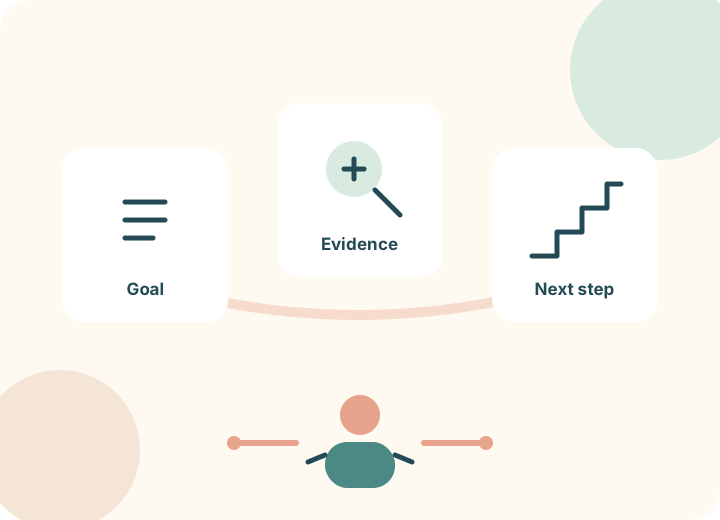
Decide what improvement would mean
A useful goal connects to everyday life: asking for help during work, joining a family activity safely or recovering with support after a difficult transition. Fewer incidents may matter, but they are only part of the picture.
Ask what the child values. An older child may want to manage a particular classroom activity or have more independence. A younger child may show preferences through choices, comfort and participation rather than a formal conversation.
Use a small amount of relevant information
Choose observations that fit the goal. You might record whether a help request was available and used, whether support allowed participation, or how much recovery time was needed. Keep the method practical enough to use consistently.
Compare similar situations where possible. A week with no school or fewer demands is not directly comparable with a full school week. Note illness, disrupted sleep or changes in staffing so the numbers are not interpreted without context.
Look for unintended effects
Ask whether the child is becoming more distressed, withdrawn or reluctant to take part. Quietness by itself is not evidence of wellbeing. Consider whether a plan is exhausting carers, difficult for staff to use or restricting ordinary activities unnecessarily.
Worsening behaviour should not automatically be described as proof that the intervention is working. Significant escalation or new safety concerns need a prompt professional review. Essential needs and communication support should remain available.
Bring clear questions to a review
Ask what the observations support, what remains uncertain and whether the original explanation still fits. Discuss whether the child needs different teaching, a more accessible task, a health review or another professional’s input.
An illustrative review might find fewer shouting incidents but no increase in participation because difficult activities have disappeared entirely. That is useful information: the next step may involve adapting an activity safely, not simply declaring the goal achieved.
Compare a small example fairly
Illustrative record: in one week a child requested help during one of four homework opportunities; the next week, during three of five. Note whether requests were prompted, whether help arrived and whether the tasks were comparable. These numbers organise the discussion; they do not prove why the change happened.
A week with less shouting could also contain fewer activities, longer recovery or more adult assistance. Add those observations before deciding whether to continue or alter the plan. Ask the child what felt easier or harder in a way they can answer.
Turn the review into a specific decision
If the plan helps and is manageable, agree what to keep. If the child cannot use a skill, check whether it was accessible and actually taught. If a practical barrier prevented support, fix the barrier before judging the strategy. New distress, discomfort or safety concerns may require a different assessment or earlier professional contact.
Write down the decision, the person responsible and the next review point. Keep a brief record of why the change was made so that a new carer or clinician understands it. Avoid a cycle of adding more targets before checking whether the first priority has become more useful in daily life.
Agree what happens next
Keep, adjust or stop elements of the plan based on benefit, safety and feasibility. Record who will do what and when to review again. There is no universal number of sessions or fixed order in which every child improves.
At IDTC, ask how progress will be discussed and what information you should bring between appointments. If a plan is not helping, you are entitled to ask for an explanation and alternatives. Support should remain collaborative and responsive to the child’s changing needs.