Bubbles
Honestly, bubbles feel like magic to a little one — and every single one is a chance for your child to say “more”, “pop” or “again”.
Blow one, then pause and wait — let your child ask before you blow the next.
The toys that help child development most are usually the plainest ones — bubbles, blocks, balls, a few little figures and a picture book. Open-ended toys leave the talking, thinking and moving to your child instead of doing it for them. Here’s what to choose, grouped by the skill it builds, and how to use it.
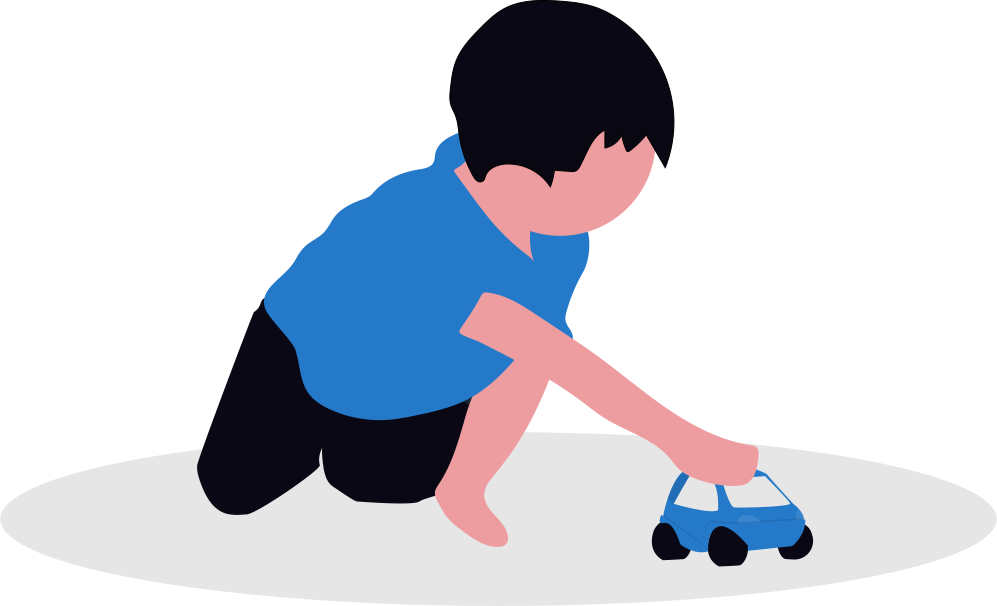
The toys that help most are open-ended ones your child can use in many different ways: bubbles, blocks, balls, shape sorters, play dough, toy animals and picture books. They leave the talking, thinking and moving to your child instead of doing it for them. Price and batteries do not decide how much a toy helps.
The best toy is you. Nothing on a shelf replaces playing and talking with your child. What follows are simple, open-ended types of toy, not brands, and most have a stand-in already in your kitchen or cupboard. Pick a couple, and let your child lead the play.
This guide comes from what we watch children do, week after week, on the floor of our sessions at our children’s therapy centre in Multan. Nothing here needs a big spend. If you’re not sure which skill to work on first, our child development check takes a couple of minutes and points you at a starting place.
Choose by stage, not by the number on the box. A toy helps when it sits just above what your child can already do. If your child is still exploring by mouthing, banging and dropping, a jigsaw marked “3+” will be ignored — a set of stacking cups will not. Watch the play first, then pick.
Play grows in a fairly predictable order, whatever a child’s age. Find the rung your child is on now, then offer the one just above it. If you’d like the wider picture, our guide to the stages of child development from 0 to 6 sets play alongside talking, movement and self-care.
The toys we love most for language are the open-ended ones — the sort that give your child a reason to point, name, ask for more and pretend.
Speech & Language TherapyHonestly, bubbles feel like magic to a little one — and every single one is a chance for your child to say “more”, “pop” or “again”.
Blow one, then pause and wait — let your child ask before you blow the next.
Pretend play is language in action. Feeding a doll or “cooking” dinner pulls out words, little roles and the first simple stories.
Sharing a simple book does more for vocabulary than almost anything else — and don’t worry, your child will happily hear the same one a hundred times.
Chat about the pictures instead of just reading the words on the page.
A handful of little characters is enough to spark naming, silly sounds (“moo!”) and short adventures you narrate together.
These give little hands a proper workout — building the grip and control your child needs for dressing, feeding and, further down the line, writing.
Occupational TherapyGrasping, placing and balancing all ask for careful hand control — and steady hand-eye coordination too.
Turning a piece until it finally fits works both problem-solving and finger dexterity at once.
Squeezing, rolling and pinching is brilliant for strengthening little hands — and, on a hard day, wonderfully calming.
No need to buy it — flour, salt and water make a batch at home.
Both hands working together, with a good dose of focus and patience thrown in.
Give your child a small puzzle to crack and you’re growing attention, memory, cause-and-effect and the very start of maths thinking.
Developmental AssessmentPlanning, matching and sticking with it — all rewarded by that satisfying last piece.
Grouping by colour, shape or size quietly builds early thinking and new words at the same time.
Perfect for younger children working out the big idea: “I do this, and that happens.”
A quick, motivating game that stretches working memory and gives you both a reason to take turns.
Active toys that build the big, whole-body strength, balance and motor planning your child needs to move with confidence.
Gross vs fine motor skillsRolling, throwing, kicking and catching build coordination — and a lovely bit of back-and-forth with you.
They strengthen legs, core and balance while your child is simply having fun.
Hopping and balancing from one to the next builds gross motor planning — and cushions from the sofa work just as well.
Calming, tactile toys for the child who craves sensory input — or who feels swamped by it and needs a way to settle.
Sensory ProcessingThey give busy hands something to do, and for many children they’re genuinely calming and grounding.
The different textures offer gentle, organising input your child can explore at their own pace.
Pouring and scooping is some of the most absorbing, calming play there is.
A washing-up bowl of water and a few cups is genuinely all you need.
Sit facing your child, down at their level, and follow whatever they are already interested in. Say one short word or phrase for what they are doing, then stop and wait. Waiting five silent seconds does more than any toy — it leaves a gap your child can step into.
Short and often beats long and rare — ten focused minutes is plenty. There are more gentle prompts like these in our little reminders for the hard days.
In a first session the toy is almost beside the point. While your child plays, we are looking at:
The first thing that shifts is usually not words. It’s the looking: your child checking in with your face more often, and letting you into the game. Talking tends to follow that, not lead it.
Play develops at very different rates, and a slow start is common. It’s worth asking someone if your child rarely looks at you during play, doesn’t copy simple actions, uses every toy in exactly the same way and is very distressed by any change, or has lost play or words they clearly had before.
None of that is a diagnosis, and none of it means you’ve done something wrong. It means a question is worth asking now rather than in a year — early support is easier work for everyone, especially your child.
One thing to rule out first: if your child doesn’t turn to their name or to sounds behind them, ask your doctor about a hearing check before anything else. Hearing sits underneath play, speech and attention alike.
If any of this sounds like your house, our page on common situations parents recognise may put words to it. If you already have a diagnosis and don’t know where to start, read what to do after a diagnosis.
Parents often ask us about toys in Urdu, so here is the same advice in a few short lines.
Roman Urdu: mera bacha khilonon se khelta nahi · sirf gaari ke pahiye ghumata hai · khilone line mein lagata hai · aik jagah nahi baithta — if one of those sentences is the one going round your head, you’re in the right place. Call or message us in Urdu or English, whichever is easier for you.
Honest answers, because helping your child shouldn’t mean spending big.
No — and please don’t feel you have to. Children learn most from simple, open-ended toys and from playing with you. Everyday things around the house — boxes, cups, pots, a ball — are often the best toys of all. It really is the time together, not the price tag, that moves things along.
The best ones can be used in lots of different ways, suit the stage your child is at, and leave the thinking, talking or moving to your child rather than doing it for them. A toy that lights up and sings is fun — but a plain box of blocks usually does far more.
Fewer than you’d think. Too many out at once tends to overwhelm and scatter attention. Try putting out just a few and swapping them around — most children play longer and more deeply when there’s less to choose from.
Toys that give your child a reason to communicate, rather than toys that do the talking. Bubbles, wind-up toys, balloons, a ball rolled back and forth, and a jar with a tight lid all create a natural moment where your child needs you. Do it once, then pause and look expectant. A sound, a point or a look all count as a turn.
We wouldn’t tell you to throw them out. What we notice in sessions is simpler than that: when the toy does the talking, the adults in the room talk less, and the child has less reason to. Keep one or two for fun, and keep the quiet, open-ended toys for the times you sit down to play together.
On its own, no. Plenty of young children sort, line up and spin things, and it can be a genuine interest. What matters is the wider picture: does your child look at you while playing, copy what you do, and let you join in and change the game? If play is always identical and any change is very distressing, that is worth a conversation.
There is no special aisle you need to find. Choose for the stage your child is at and for what their body seeks — some children settle with squeezing, deep pressure and water play, others need movement first. Watch which toys calm your child and which wind them up, and build the shelf around what you see.
Don’t start by taking the phone away. Start by making the alternative worth it: sit on the floor, pick one toy your child already likes, and play it noisily and happily yourself for a minute without asking anything of them. Curiosity usually beats instruction. Then keep screens out of the room for that short play window.
Wondering what to actually do with these toys? See our play & games ideas, or read why play matters so much. For questions about sessions, timings and getting started, our therapy FAQs for Multan parents cover the rest.
Tell us your child’s age and what you’re working on, and we’ll suggest toys and games that fit them just right.
MPS Road, Block A Model Town, Multan (near Bloomfield Hall School, Street No. 2) · Mon–Fri, 2 PM – 6 PM