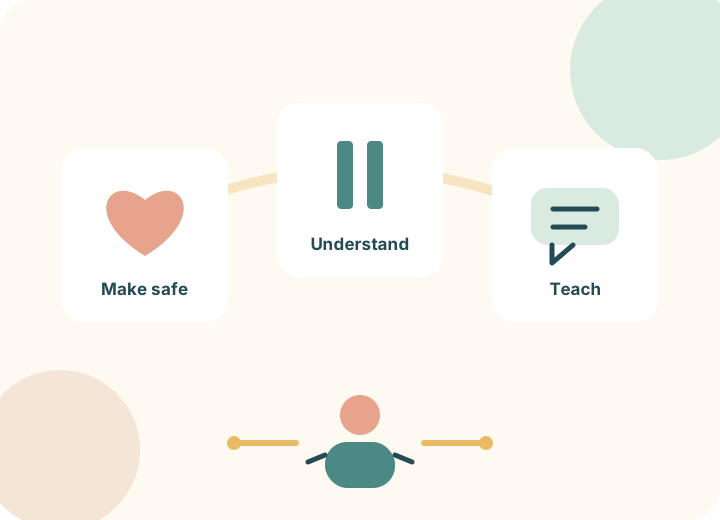
First separate play from a safety concern
Throwing a soft ball during play is different from throwing a hard object towards another person. Consider the child’s age, the object, the setting and what happened beforehand. The same movement may be exploration on one occasion and a sign of distress on another.
Describe what happened without assigning a motive. “Threw the cup after the drink spilled” gives you a starting point. “Is aggressive” does not explain whether the child needed help, was startled, wanted to finish or had another difficulty.
Respond to immediate risk
Move other children away from danger and remove accessible hazardous objects when you can do so safely. Keep your words short and calm. Attend to anyone who has been injured. If you cannot keep people safe or someone is seriously hurt, seek urgent help.
Do not throw something back, threaten the child or try an improvised restraint technique. A repeated pattern involving dangerous objects needs an individual professional safety plan. Ordinary activity should not be used as a test to see how far the behaviour will escalate.
Look at the setting once everyone is safe
Notice whether throwing occurs during meals, transitions, difficult tasks or crowded play. Check for tiredness, discomfort, communication difficulty and the demands of the activity. Look for occasions when the same situation goes more smoothly.
An ABC note can help organise observations. It cannot establish that throwing is for attention or escape after a single event. Ask the child about their experience when calm, using their preferred communication method.
Teach an alternative that fits the situation
If the child needs to finish, practise a simple “finished” signal and provide somewhere to place an unwanted item. If they need help, make a help request easy to use. If throwing is part of play, arrange a safe place and suitable soft objects rather than treating every throw as unwanted.
Practise when the child is settled. For example, model placing a toy in a finished box at the end of a short activity. Notice attempts to use the alternative. Adapt the idea to the child rather than relying on a reward chart to solve an unknown cause.
Match the alternative to the routine
At a meal, an illustrative alternative is an easy-to-reach place for an unwanted cup and a familiar “finished” gesture. During a difficult puzzle, it may be handing a piece to an adult for help. During outdoor play, it may be throwing a suitable soft ball into an agreed open space. These alternatives serve different purposes; a single rule to “keep hands still” would miss those differences.
Check whether the child can physically use the alternative and whether adults respond to it. If the finished box is out of reach or the help request is repeatedly missed, adjust the arrangement. Practise with ordinary safe materials while calm, without setting up a distressing test.
Plan for shared spaces
If other children share the room, agree where they can move and which adult will supervise them if an incident begins. Keep hazardous items stored appropriately without removing every ordinary activity. The arrangement should fit the actual risk and be reviewed with professional help when throwing is dangerous.
After everyone is safe, note the object, distance, any injury, the preceding activity and what helped recovery. Discuss repair when the child can participate, such as putting safe items away together. Avoid forcing a child to handle broken or dangerous objects as a consequence.
Review repeated incidents
Seek support if throwing is frequent, dangerous or restricting family or school activities. Bring examples of the situations and what has already helped. A review may involve communication, learning, sensory, emotional or health needs as well as behaviour support.
Progress might mean asking for help sooner, safer participation or quicker recovery. If the child is increasingly distressed, review the plan promptly instead of assuming that escalation is an expected stage of improvement.