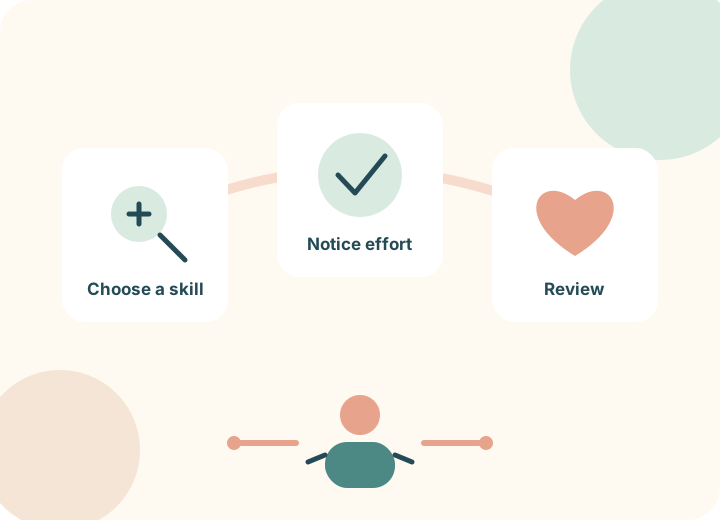
Start with a skill worth building
Positive reinforcement involves a helpful consequence that makes a behaviour more likely in the future. In everyday support, first decide what useful skill you want to encourage: asking for help, putting a toy in a safe place or joining a short activity with support.
A goal such as “be good all day” is vague and hard to achieve. Choose something the child understands and can practise. Harmless movement, natural preferences and appropriate expressions of discomfort should not become targets simply because adults find them inconvenient.
Make encouragement meaningful to the child
Some children enjoy specific praise, shared play or choosing an activity. Others dislike public praise or find a large reward system confusing. Ask about preferences and notice what the child actually welcomes.
Describe the action: “You showed me the help picture.” Keep the response close enough to the action that the connection is understandable. Encouragement does not need to be expensive, and it should not depend on competing with other children.
Use charts only when they help
A token board can make a small goal visible, but it is a tool rather than a complete behaviour plan. Explain the target and what happens when it is reached. Keep the first step achievable and provide the support needed to succeed.
For example, a child might mark one supported attempt to tidy a small set of toys, rather than earn a star only after independently cleaning a whole room. If the chart repeatedly produces frustration, reconsider the task, communication and expectations instead of adding more rules.
Keep basic needs and dignity outside the system
Food needed for health, water, toilet access, sleep, safety, comfort and communication support should not have to be earned. A child should not lose an essential aid because of a difficult day. Avoid public behaviour rankings or using affection as a bargaining tool.
When distress occurs, address safety and the underlying need. Reinforcement should accompany accessible teaching and appropriate boundaries; it should not be used to make a child tolerate pain, overwhelming demands or unwanted physical contact.
Work through one achievable target
Illustrative goal: putting a used toy in its box with help at the end of play. The adult places the box nearby, models the action and notices an attempt. “You put the car in the box” makes the response specific. If the child needs assistance, that can count within the agreed goal; independent room-cleaning is a different task.
Check what encouragement the child welcomes. Shared play may work better than a sticker for one child, while another may like a simple visible mark. The arrangement should explain what happens next without making basic care or the relationship conditional on success.
Troubleshoot before making the reward bigger
Ask whether the child understood the target, could perform it with the available help, and recognised the response as meaningful. A weekly chart may be too distant or complicated for the particular child. The next step may be a smaller goal and clearer teaching, not a more expensive prize.
If the child succeeds only with one adult, practise the useful skill in another ordinary setting with support. Do not remove all help at once to test independence. Review whether the skill brings a real benefit, such as getting help or finding belongings, beyond collecting marks on a chart.
Review and build everyday usefulness
Ask whether the child is learning a useful skill and whether it works outside the practice activity. Gradually connect the skill to its natural benefit: a help request brings help, and putting things in a familiar place makes them easier to find.
If a reward system is not helping, it may be the wrong tool, the goal may be too hard or another need may have been missed. Parent coaching can help adapt an approach. There is no universal prize or chart that works for every child.