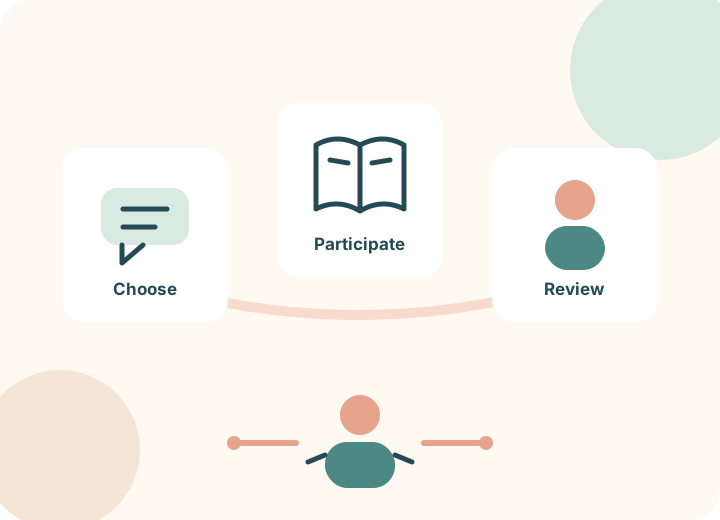
The main points in simple words
- You can say what matters to you.
- You can ask for help and still make choices.
- Choose one useful goal at a time.
- Tell a doctor about new health concerns.
Choose the question you want to explore
Daily living skills for adults with Down syndrome
Plan adult daily-living support around chosen routines, practical adjustments, privacy and useful progress, with examples for shopping and household tasks.
Read the guide →Communication and AAC for adults with Down syndrome
Explore adult communication support, AAC, conversation adjustments and a communication passport, with practical examples for appointments and community life.
Read the guide →Work preparation for adults with Down syndrome
Plan work preparation with an adult with Down syndrome: interests, task practice, workplace adjustments, transport, support and questions for employers.
Read the guide →Friendships and community life for adults with Down syndrome
Support adult friendships and community participation through shared interests, accessible plans, personal boundaries and practical ways to stay in touch.
Read the guide →Supported decisions for adults with Down syndrome
Help an adult with Down syndrome understand options and express choices using accessible information, time, trusted support and clear limits on others’ roles.
Read the guide →Preparing health appointments with an adult with Down syndrome
Prepare for an adult Down syndrome health appointment with an accessible agenda, observations of changes, current records and clear follow-up questions.
Read the guide →Start with adult priorities, not a childhood timetable
An adult with Down syndrome may want to keep a friendship, learn a work task, travel with support or have more privacy at home. Ask about these priorities directly, using the person’s preferred communication. Being an adult does not depend on speaking fluently, reading independently or completing every personal-care task alone. Avoid using a child’s developmental age as a description of the whole person.
A practical starting conversation has three parts: what is going well, what feels difficult, and what the adult wants to change. A supporter can contribute observations without replacing the person’s answer. Write down disagreements as disagreements rather than quietly selecting the family’s preferred goal. Some goals may concern changing the environment or other people’s behaviour, not teaching the adult another skill.
Build a small plan that connects everyday settings
For an illustrative example, an adult wants to buy stationery at a nearby shop. One difficulty is explaining the item; another is handling payment in a busy queue. A useful plan might include a photo of the item, a quiet practice visit and an agreed payment method. Those are separate barriers, so record which change helps. Buying everything without assistance is not the only meaningful outcome.
Name the goal, the help agreed, who will provide it and when the person wants to review it. Ask whether the activity is enjoyable and worth the effort. If the shop changes its layout, refresh the plan instead of interpreting a new difficulty as lost ability. The six guides in this section provide more detailed examples for different situations.
Plan the transition from school before support disappears
When leaving school or changing providers, make a list of what will stop, what could continue and what is still uncertain. Include communication aids, friendships, daytime activities, transport and health appointments. Ask each current service about its own age limits and handover arrangements; do not assume the next provider receives records automatically.
Choose a person to coordinate enquiries with the young adult’s involvement. A brief handover can describe interests, communication preferences, useful adjustments and current goals. Agree which information may be shared and with whom. Confirm the first contact and any waiting period for the next service. UK transition guidance informs these planning principles, but its service entitlements and timelines are not Pakistani arrangements.
Distinguish learning support from medical care
Psychological, communication and daily-living support can address participation goals. Medical assessment addresses health questions and may require a doctor or other qualified specialist. A sudden change in participation should prompt consideration of health, distress and the environment rather than an automatic increase in behavioural demands.
Use the health-appointments guide to organise questions and records, not to choose tests or diagnose a condition. If several professionals are involved, ask who is responsible for each concern and who will explain the next step. Record unresolved questions so that a referral does not become a dead end.
Respect choice, privacy and the right to ask for help
Offer information in a way the adult can use and allow time for a response. Ask before involving relatives in sensitive discussions. A supporter’s role might be reading a letter, remembering questions or helping explain a preference; that does not mean taking over every decision. For important decisions involving treatment, money or legal authority, obtain appropriate local professional advice.
Families also need workable arrangements. Discuss who can offer support, what happens when that person is unavailable and which tasks require specialist input. A shared plan should record the adult’s preferences alongside practical limits. Do not promise independent living, employment or a particular level of ability as an outcome of a programme.
Enquiring about adult support at IDTC
IDTC offers adult psychological, behavioural, communication and daily-living support in Multan and online by arrangement. For an adult with Down syndrome, ask whether a clinician has the relevant experience for the particular goal and whether an appointment is suitable. These educational guides do not establish a dedicated Down syndrome clinic, medical screening service, job-placement programme or supported-housing service.
Before booking, explain communication and access needs, who the adult would like involved, and whether an online conversation is practical. Confirm the clinician, fee and scope. The centre has parking and a customer toilet, but the entrance is not currently wheelchair accessible. For a child or teenager seeking current child services, use the separate children’s pathway.
A starting plan to discuss together
Use these prompts in a private note or print this page. This website does not collect your answers. Examples are illustrative; adapt them with the adult.
| Question | What to record |
|---|---|
| What matters to me? | A goal expressed in the adult’s own words or communication. |
| What gets in the way? | One specific barrier in one real setting. |
| What help do I want? | The agreed adjustment and who provides it. |
| When will we review? | A date chosen together and what success would feel like. |