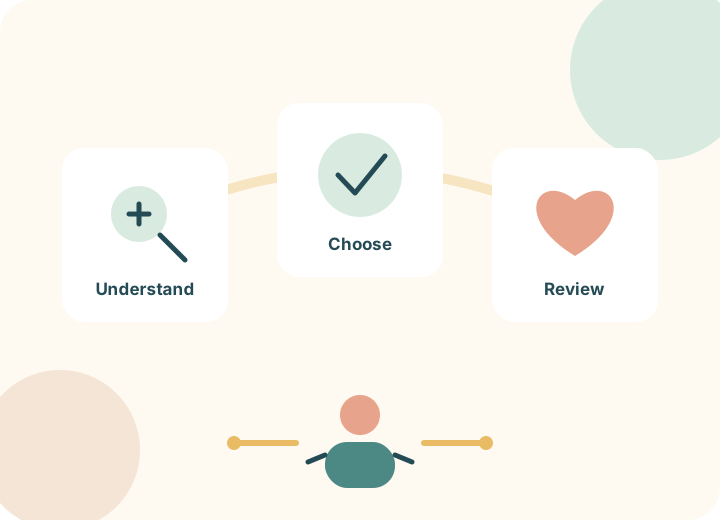
The main points in simple words
- Tell me what the choice is.
- Explain each option in a way I understand.
- I can ask for more time or help.
- Check what I want instead of assuming.
Explore this topic in more detail
Name the actual decision
Begin with one clear question, such as choosing an appointment time or deciding whether to try an activity. “Can this person make decisions?” is too broad to guide useful support. A person may manage some decisions easily and need substantial help with others; communication differences alone do not explain what someone understands.
Clarify why a decision is needed, the available options and any real deadline. Avoid inventing urgency to get an answer. If there are practical limits, explain them honestly. For example, saying “these are the two available appointment times” is more transparent than presenting one preferred time as the only reasonable choice.
Make information usable and balanced
Use a format that fits the person: plain language, spoken explanation, a demonstration, photographs, writing or communication aids. Give the important differences between options without overwhelming detail. Ask what needs explaining again and check understanding through the person’s own words or another appropriate method, rather than relying only on a yes response.
Do not frame one option as pleasing the family and the other as being difficult. The adult should be able to disagree, ask questions and reconsider. NICE guidance describes accessible information, time and freedom from coercion as elements of decision support; its UK legal framework should not be treated as Pakistani law.
Worked example: choosing an appointment format
Imagine an adult deciding between an online appointment and an in-person visit. Explain concrete differences: travel and entrance access, a private place at home, internet reliability, who can attend and whether the clinician considers both formats suitable. The adult may want to see the video setup or ask about the waiting room before deciding.
A supporter writes down the questions and helps compare the options. The adult chooses online but asks a relative to help start the call and then leave. Record that preference and check it at the appointment. The example illustrates a process; it does not establish that online care is suitable for every concern.
Agree the supporter’s role and protect privacy
Ask whom the adult trusts and what help they want from that person. Roles might include reading information, arranging transport, remembering questions or helping communicate a choice. Ask separately what may be shared afterwards. Attendance at an appointment should not be interpreted as unrestricted permission to disclose all information.
Where views conflict, distinguish the adult’s preference, the supporter’s concern and the professional’s assessment. Seek an appropriate independent perspective when needed. Do not describe silence, dependence on a carer or compliance with instructions as proof of consent. For high-stakes treatment, financial or legal decisions, qualified local professionals must address the relevant requirements.
When a decision remains difficult
Consider whether the information, timing, environment or communication support could be improved. Fatigue, distress or an unfamiliar setting can make a discussion harder. A further conversation may be useful when there is time, but urgent care decisions need appropriate clinicians and must not wait for a home worksheet.
This guide does not assess legal capacity, grant a relative authority, explain guardianship law or establish consent for a particular procedure. If there is uncertainty about authority, coercion, abuse or a consequential decision, obtain suitable local medical, safeguarding or legal advice. Keep involving the adult as appropriately as possible rather than excluding them from the conversation.
Record the person’s view and follow through
A short record can state the decision, options explained, support used, the adult’s expressed preference and unresolved questions. Record how the preference was communicated without interpreting every gesture as a definite answer. Ask the adult whether the record represents their view and who may receive it.
Review whether the agreed choice was implemented. If an appointment format or activity must change, explain why and discuss alternatives. Meaningful participation includes seeing that a preference affects what happens next. IDTC can discuss relevant communication or psychological support; these pages do not advertise legal-capacity certification or legal representation.
Decision conversation record
Use these prompts in a private note or print this page. This website does not collect your answers. Examples are illustrative; adapt them with the adult.
| Prompt | What to write |
|---|---|
| Decision and deadline | The specific choice and any genuine time limit. |
| Options explained | Balanced information and the format used. |
| Support chosen | Who helped, and what the adult wanted them to do. |
| Person’s view | Their words or a careful description of their communication. |
| Unresolved questions | What needs clarification and by which professional. |