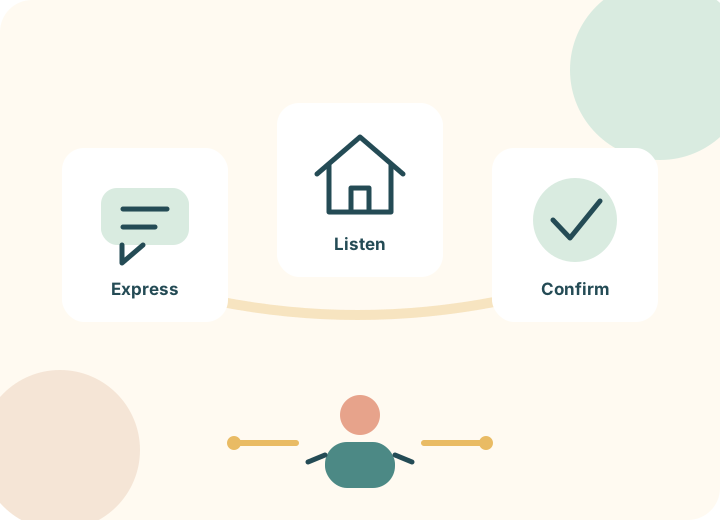
The main points in simple words
- Speak to me directly.
- Give me time to answer.
- I can use speech, pictures, signs or a device.
- Ask if you understood my message correctly.
Explore this topic in more detail
Begin with the communication situation
Choose one situation that is difficult: being heard at reception, joining a conversation, understanding a work instruction or explaining a problem. Describe what the adult already does successfully and what the listener finds unclear. Speech clarity, understanding language, hearing, access to an aid and the pace of conversation are different questions; they should not be treated as one general inability.
Ask the adult what they would like help with. Someone who enjoys talking may want listeners to stop interrupting; someone who uses a device may want more time or better access. A speech and language professional can assess relevant needs and discuss suitable approaches. A new or marked communication change also warrants consideration of medical causes.
What AAC can contribute
Augmentative and alternative communication, or AAC, includes methods used alongside speech or in place of it, such as gestures, writing, pictures and speech-generating systems. The right approach depends on the individual, the setting and physical or sensory access. It should allow meaningful adult messages and remain available when the person needs it.
Do not choose an expensive device only because it worked for someone else. Ask about assessment, a practical trial, vocabulary, the languages used at home and ongoing support. Consider what happens if a battery runs out or a device is unavailable. A simple backup should be understandable to the person and their communication partners.
Change the listener’s approach as well
Speak directly to the adult and introduce the subject before asking a question. Allow a pause and avoid filling every silence. If a message is unclear, explain what you understood and ask about the missing part. Repeatedly saying “say it properly” can leave the person without a useful way to repair the conversation.
For an illustrative example, an adult tells a receptionist something about an appointment but the time is unclear. The receptionist says, “I understood you have an appointment today. Can you show me the time?” The adult may use a phone message, a card or another method. This checks a specific detail while preserving the person’s role in the exchange.
Create a communication passport with permission
A short passport can explain the person’s preferred name, languages, communication methods, how they show disagreement and what helps when a message is missed. Make it with the adult and check whether the descriptions still fit. It is a prompt for respectful interaction, not a replacement for speaking with the person.
Include only information needed by the intended reader. A shop assistant does not need medical history, and a workplace does not automatically need private family details. Decide where the passport is kept, who may receive a copy and how it will be updated. Avoid placing sensitive personal information on a publicly accessible page or QR code.
Practise real messages in adult settings
Choose useful messages such as “that is not what I meant”, “please explain”, “I need a break” or a question about a shared interest. Agree how the person wants to practise. Adult interests and vocabulary should guide materials; a child-focused worksheet may be inappropriate even when the communication task is simple.
Notice whether a message works with different people, not just a familiar therapist. If a friend cannot recognise a gesture, the solution may include teaching the listener or adding a second method. Do not withhold an aid or ignore a clear message to demand speech. The purpose is participation and being understood, not performance of a preferred method.
Questions for a communication appointment
Bring examples of situations, existing aids and the adult’s priorities. Ask what the assessment will examine, how hearing or vision concerns will be addressed and what support listeners will need. Confirm the clinician’s experience with adults and whether the suggested tools can be used in the person’s languages and environments.
Agree how to judge usefulness: fewer unresolved misunderstandings, greater ability to express an opinion or less effort in a chosen conversation. These are examples, not promised outcomes. IDTC accepts enquiries about adult communication support; confirm suitability and scope before booking. Feeding and swallowing concerns require a suitably qualified specialist and are not covered by these communication exercises.
A private communication passport outline
Use these prompts in a private note or print this page. This website does not collect your answers. Examples are illustrative; adapt them with the adult.
| Prompt | Write with the adult |
|---|---|
| How I communicate | Speech, writing, gestures or aids I choose to use. |
| When you do not understand | A useful way to check my meaning. |
| How I say no or ask to stop | My words, signals or messages. |
| What helps me follow a conversation | Language, pace, environment or format. |
| Sharing and review | Who may see this, and when we will check it again. |