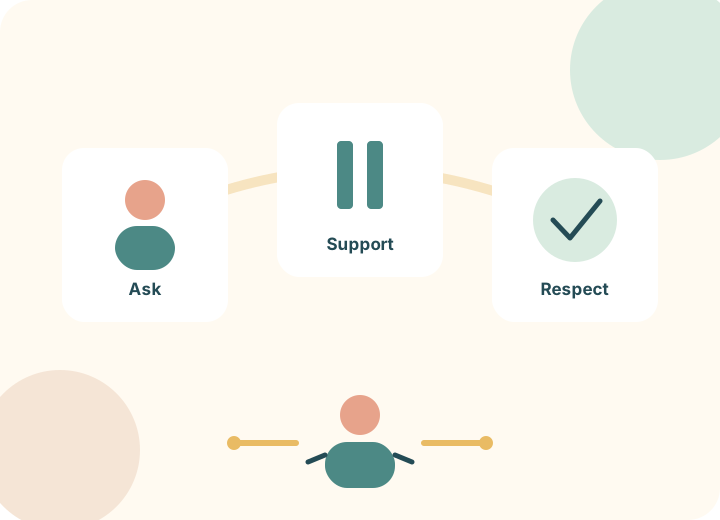
The main points in simple words
- Ask what help I want.
- Speak to me as well as my supporter.
- Check what information I want shared.
- I can ask to change the arrangement.
Separate practical help from decision authority
A supporter might book transport, read an appointment letter, help recall questions or assist communication. These are different tasks from consenting to treatment or receiving all clinical records. Write down the help the adult wants so everyone understands the role before arriving.
Do not assume that being a parent, sibling, spouse or regular carer automatically authorises every action for an adult. If a consequential decision or formal authority is involved, ask the provider about the applicable local requirements and obtain appropriate professional advice. This page offers a conversation framework, not a legal opinion or a determination of decision-making capacity.
Agree a plan before the appointment
Ask whether the adult wants the supporter present for the whole visit, only the introduction or particular questions. Discuss how the person will signal that they want help, a break or privacy. Use their preferred communication rather than a form they cannot understand. The adult may want to reconsider after meeting the clinician.
Contact the provider about practical arrangements, including interpreting, communication aids, physical access and time for questions. Confirm what can actually be offered. A request written in a planning sheet does not establish that the clinic has accepted it, so check important arrangements before travelling.
Worked example: help with notes, privacy for a concern
Imagine an adult who wants a sister to help remember the appointment questions but prefers to discuss one personal concern alone. Before the visit they agree that the sister will share the question list, then step out when asked. The clinician checks the arrangement directly with the adult rather than relying only on the sister’s account.
After the private discussion, the adult and clinician decide what can be explained when the sister returns. The supporter does not automatically receive every detail simply because they arranged transport. This example illustrates a preference to discuss; the clinician must address the actual consent, safety and legal requirements of the situation.
Distinguish observations from interpretations
A supporter may have useful information about a change in sleep, a missed activity or difficulty using an aid. State what was observed, when it occurred and whether the adult agrees with the description. Avoid replacing the person’s account with labels such as “always difficult” or claiming to know why an event happened.
When accounts differ, record the difference respectfully. The clinician can ask questions and assess relevant concerns. Do not pressure the adult to repeat a supporter’s preferred explanation to keep the appointment moving. If interpretation or specialised communication support is needed, discuss that need explicitly rather than treating a familiar relative as an automatic substitute.
Make sharing preferences specific and reviewable
Ask which information may be shared, with whom and for what purpose. Receiving an appointment reminder, collecting a prescription and viewing a full medical record involve different information and responsibilities. If online account access is needed, use the provider’s authorised process rather than sharing passwords or assuming access is permitted.
NHS family-and-carer access guidance provides a UK example of formal arrangements; its procedures are not automatically available in Pakistan. Ask the actual provider how sharing preferences are recorded and changed. Providers also have responsibilities concerning safety and confidentiality, so a home planning sheet cannot override their professional or legal duties.
Review whether the adult’s voice was preserved
After the visit, ask whether the adult had enough opportunity to speak or communicate, whether the support was useful and whether any boundary needs changing. If the supporter answered too quickly, agree a clear pause or signal for next time. If the person wanted more help, identify the specific point where it would have been useful.
Keep the plan short and current. A change of clinician, supporter or appointment purpose may call for another conversation. IDTC can discuss the appropriate role of a chosen supporter in adult therapy appointments. Concerns about coercion, abuse or legal authority require suitable local professional advice and should not be resolved by simply asking the adult to sign this worksheet.
Supporter role conversation sheet
Use these prompts in a private note or print this page. This website does not collect your answers. Examples are illustrative; adapt them with the adult.
| Topic | Preference to discuss |
|---|---|
| Before the visit | Help with transport, letters, questions or communication. |
| During the visit | When the supporter should contribute and how to ask for a pause. |
| Private discussion | Whether the adult wants time without the supporter. |
| Sharing afterwards | Which information may be shared, with whom and why. |
| Review | What worked, what should change and whom to inform. |