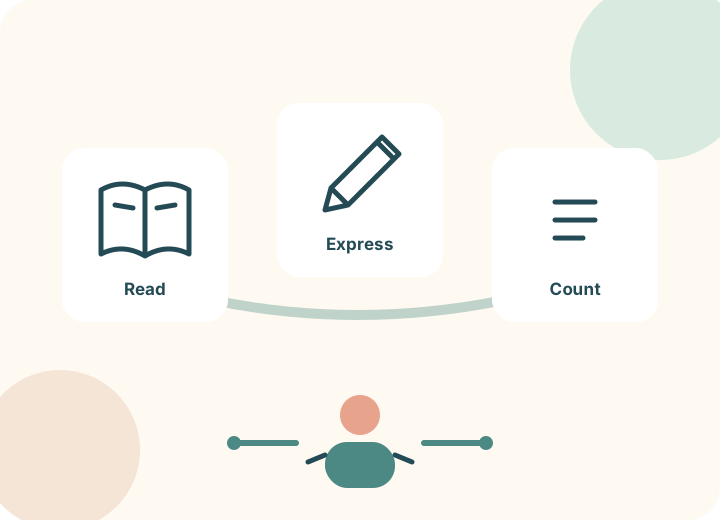
Begin with the child’s current skills
Ask what the child understands, recognises and can communicate during a familiar learning activity. Looking at a book, identifying a word, understanding a sentence and producing a written response are different skills. A single score or a list of memorised words does not describe the whole profile.
Agree a useful next question with the educator. Can the child connect a familiar word to its meaning? Can they show a quantity with objects? Can they express an answer when pencil control is difficult? The response method should not hide what the child knows.
Connect reading with meaning and language
Down Syndrome Education International’s Reading and Language Intervention combines word reading, sound-and-letter work, book reading and language teaching. Its published guidance describes a specific programme and study population; it is not a claim that IDTC delivers that programme or that every child will achieve the same result.
For an ordinary illustrative activity, choose a short book the child enjoys. Discuss a familiar object or action and let the child respond through speech, pointing, sign or their communication system. Ask the educator how the book activity connects with explicit teaching of the reading skills the child currently needs.
Distinguish remembering a page from understanding it
A child may recognise a familiar page or recite a repeated line. That is useful information, but it does not answer every question about reading. Try a different meaningful context with appropriate support, such as finding the same familiar word on a label and connecting it to the object.
Keep the activity supportive rather than a surprise examination. If understanding is uncertain, show the meaning and discuss the next teaching step. Avoid treating a mistake as evidence that reading is beyond the child; equally, avoid claiming comprehension from successful repetition alone.
Separate writing ideas from handwriting demands
Ask whether the goal is expressing an idea, spelling, forming a letter or controlling the writing tool. These may need different supports. A child could choose pictures, dictate, use a communication device or select letters to show an answer while handwriting is addressed separately where appropriate.
Illustrative classroom task: describe a favourite activity. The child first communicates the idea in an accessible way; the educator then selects a manageable writing step. Persistent pain, fatigue or difficulty manipulating materials deserves professional discussion rather than more copying as the only response.
Build number meaning with useful objects
Counting aloud is different from matching a number to a quantity. In an illustrative activity, put one cup at each place for a small family meal and discuss how many are needed. Notice whether the child matches objects to places, follows the sequence and understands when there are enough.
Adapt the number of objects, instructions and response method to the learner. For older children, use age-respectful contexts such as organising personal belongings or planning materials for an activity. Avoid assuming money or community safety skills from success with a classroom number exercise.
Review teaching and opportunity together
Ask what was explicitly taught, what assistance was available and whether the child had a fair chance to practise. Keep examples of work with a note of the support used. A page completed by an adult holding the pencil does not demonstrate the same skill as the child independently communicating an answer.
Discuss literacy and numeracy within the individual learning plan, alongside functional participation and interests. There is no fixed ceiling or guaranteed timetable that a webpage can assign. IDTC can discuss special education and learning goals; confirm the teacher’s approach, assessment and review arrangements.