Autistic Masking in Children: Fine at School, Crash at Home
Written by the Inclusive Developmental and Therapy Center therapy team — our Speech & Language Therapist, psychology and ABA staff. Clinical reviewer for this site: Dr Muhammad Suffyan, MB BS (GMC 8023727) · Updated August 2026; this page has changed since our last clinical review.
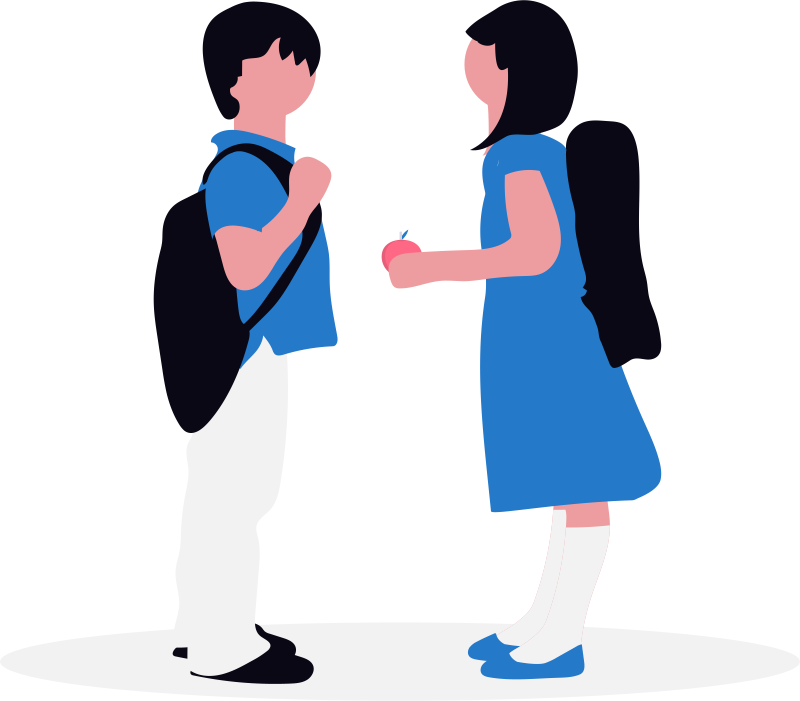
The teacher says she is a delight. She sits, she copies the board, she says ji miss at the right time. Relatives at the Sunday lunch say you are imagining it. Then the gate at home closes, the bag hits the floor, and you get two hours of screaming, or a child who will not speak until Maghrib. You are not watching two different children. You are watching the same child with the mask on, and then with it off.
Masking is the work of watching other children and copying them — the laugh, the eye contact, the corridor script — so nobody notices how hard the day is. It is more common in girls, and it is one reason autism gets missed for years. It is not a personality. It is not proof she has grown out of anything. And it is not a cure. The page that sits next to this one is autism and ADHD in girls.
What masking actually looks like in a Pakistani classroom
It rarely looks like the pictures people carry of autism. She has a friend, or at least one girl she sits next to. She recites when asked. She does not flap in assembly. She has learned that looking at the teacher’s forehead counts as looking at the teacher. At break she stands near a group and laughs half a second late. At lunch she copies whatever the girl opposite is eating, even if the texture is wrong, then comes home and will only take roti and dahi.
Boys mask too, especially quiet boys in strict schools who have been told, often, to sit still and not make a scene. They copy the boy who knows when to take out the copy, when to stand, when to say present sir. The cost is the same. The difference is that a boy who copies badly gets called naughty. A girl who copies well gets called fine.
What you will not see in the diary is the rehearsal. Many children run the day in their head the night before: where they will sit, what they will say if someone asks about the weekend, which toilet they can bear. That is not being organised. That is a nervous system trying to make a noisy, unscripted building survivable.
Fine at school, crash at home is not a contradiction
Home is safe, so the lid comes off. That is the finding, not a problem to be solved by making home as strict as school. The child who held a performance for six hours has nothing left for “how was your day,” homework, or a guest in the drawing room. The first hour after school is recovery, not a debrief. That hour has its own page: after school.
Schools often do not believe you, because they have not seen it. Write both versions down — the teacher’s sentence and what happens between four and seven — and treat the gap as information. A child who is “no trouble” in class and cannot get through a joint-family evening is not being dramatic for you. She spent the trouble where it was not allowed.
If the crash is shouting, hitting, or a child who cannot be reached, read it as overload, not manners. Meltdown versus shutdown and big feelings are the two pages for that hour. Do not add a lecture. There is nobody home to hear it.
Why girls get told they are shy, sensitive, or dramatic
The descriptions of autism most relatives know were built around a three-year-old boy who is not hiding it. A girl who points, who plays with dolls (often lining them up), who has one intense friendship, and who says please, does not match that picture. So she is shy. Then she is sensitive. Then, around ten, she is dramatic. Then, around thirteen, she is anxious, and someone treats the anxiety as the whole story.
Copying is easier to learn if you are watching girls, because girls’ groups punish difference more quietly and more thoroughly. The script is available. The price is that nobody refers her. If she is already in her teens, put this next to teenagers and autistic burnout in teenagers — masking that has run for years often ends as exhaustion, not as a diagnosis.
Aunties in a joint family are not being cruel when they say yeh to theek hai, school mein sab kar leti hai. They are reporting what they see in public. Public is where the mask is. Believe the private version.
Copying is a skill, not a cure
Families hear “she is mixing now” and feel relief. Mixing can mean she has found a way to look typical for six hours. That is useful in a classroom. It is not the same as the difficulty having gone. A child who can copy a greeting still may not know what the greeting is for. A child who can sit through a rashta still may be counting the minutes until the door.
Do not take away the copy. It is how she is getting through the day. Do not praise only the copy either — “see, you can do it when you try” — because that teaches her that the real self is the problem and the performance is the child you want. Praise the recovery. Praise the honest sentence. Praise coming to tell you the uniform scratch is unbearable, instead of waiting until she screams.
Echolalia, scripts from YouTube, repeating a teacher’s phrase at home — these are language, not empty noise. What echolalia is sits next to masking, because a lot of “copying” is how some children talk at all.
What masking costs by the afternoon
It costs attention. A child who is tracking every face in the room has less left for the sum on the board. Teachers then say she is bright but careless, or that she “drifts.” It costs food. Many masked children eat almost nothing at school because the canteen, the smell, the chewing sounds, and the social rules of the table are one demand too many. They come home ravenous and furious. It costs the body. Headaches, stomach aches, a child who needs to sleep at five, a child who cannot bear a touch on the shoulder after school.
It also costs identity, later. Teenagers who have copied for years often cannot tell you what they actually like. Ask what they want to eat and they look at your face first. That is not indecision. That is a child who has been graded on getting the answer right.
Sleep is usually short, because the brain that performed all day does not switch off at ten. Sleep is not a side issue here. A masked child who is also sleeping five hours will look, by Thursday, like a different diagnosis.
What to stop asking her to do
Stop asking her to “just try” at the wedding hall after a full school day. Stop asking for a performance for guests — reciting, serving tea with a smile, sitting in the drawing room until the last uncle leaves. Stop asking why she cannot be the same at home as she is at school. She cannot, and the fact that she is not is how you know the school version is expensive.
In a joint family this is the hard conversation. Dadi wants her to greet everyone. The child has already greeted thirty people today. One person at the door, a short salaam, then her room, is not rudeness. It is a budget. You can say, calmly, to the adult: she did the hard part at school. This hour is rest. You do not need the whole house to understand autism. You need them to stop treating recovery as a spoilt child.
Do not force eye contact to prove she is listening. Do not ban the special interest because it looks odd. Do not take away the headphones, the same cup, the same route to school, in the name of making her flexible. Flexibility is built by lowering the load, not by surprising her more. Special interests and routines and change are the two practical pages for that.
What to change this week
- The first thirty minutes after school: food, a drink, no questions, no guests if you can help it. Homework waits.
- One honest check-in later, not “how was school?” — “was the uniform all right, or was maths loud?”
- A sentence she is allowed to use when the mask is slipping: “I need a break,” a card, or going to her room without it being called attitude.
- Cut one extra. If there is school, tuition, and a Quran class on the same day, one of them is too many this term. After-school clubs is written for that choice.
- Write three days of what school reports and what you see at home. Bring that to anyone who assesses her. The mismatch is the data.
Practise the exit on a calm day. A child will not invent a new sentence at volume eight. Big feelings for older children and social skills for older children are the home programmes that sit next to this, if you want something to do between appointments.
How relatives and school talk past each other
School has a job: a quiet class. Relatives have a job: a child who does not embarrass the family in public. You have a job: a child who can still be a person at 8pm. Those three jobs fight. The sentence that helps is not “she is autistic so leave her.” It is “the well-behaved girl you saw used up the day. What you are seeing now is the bill.”
If the school wants a meeting because homework is missing, take the after-school notes, not a character reference. Ask for one change: a reduced copying load, a quiet place at break, or permission to eat the snack she will actually eat. Classroom support and a letter to school are written for that conversation. You do not need a diagnosis to ask for a smaller day.
If family says nothing is wrong, that has its own page: when family says nothing is wrong. You can still change the house even if the drawing room does not agree.
When to get a proper look
Get a look if the crash is daily, if she has started refusing school, if eating or sleep has fallen apart, if she says she wishes she were different, or if you no longer recognise her in the evenings. School refusal is not stubbornness on top of masking — it is often the mask failing. A child who refuses school and an anxious child are the next reads if that has already begun.
Lost skills, talk of not wanting to be alive, or a child who is not safe, is same-day medical care, not a therapy slot. We are a therapy centre, open Monday to Friday, 2pm to 6pm, not an emergency service. In Pakistan, 1122.
A formal diagnosis of autism is a doctor’s job — a developmental paediatrician or a psychiatrist. We do not diagnose and we do not prescribe. What we can do is describe, in plain language, what a child can and cannot yet do, and what would make the day smaller. Mahnoor Baloch, Speech and Language Therapist, leads first assessments. Child psychology here is led by Muhammad Salman Afzal.
What we do here
Inclusive Developmental and Therapy Center is in Model Town, Multan. A consultation is Rs 1,500 and lasts up to 50 minutes, in the room or online. Many girls who mask will talk more easily on video from their own room than in a clinic with a new adult. Online or in person is the honest comparison.
Bring the two reports — school’s and yours. Film thirty seconds of the evening crash if she will tolerate it, because children who mask do not perform the difficulty to order in a new room. The developmental assessment is a map, not a label. Therapy can start without a diagnosis. We see children up to sixteen.
Related: autism, emotional dysregulation, what happens in an assessment, parent coaching. WhatsApp is +92 301 6424265.
Frequently asked questions
My daughter is fine at school but falls apart at home. Is that masking?
Often, yes. She holds a performance for six hours and the lid comes off where it is safe. The mismatch is the finding, not a contradiction. Write both versions down — the teacher’s sentence and the evening — and treat the gap as data, not as you being too soft.
Does masking mean she is not really autistic?
No. Copying classmates is a skill, not a cure. The difficulty is still there; it is being spent in private. Relatives who only see the public version will say she is fine. Believe the private version.
Do boys mask as well, or is this only girls?
Boys mask too, especially quiet boys in strict schools. Girls are missed more often because the copy is praised and the checklists were built around boys who were not hiding it. The cost — exhaustion, a crash after school — is the same.
Should I make home as strict as school so she stays “good”?
No. Home is where the bill is paid. The first half hour needs food, quiet and no guests if you can help it. Making home another performance is how burnout starts. A sentence she is allowed to use when she needs a break is more useful than another lecture.
The school will not believe me. What do I take to a meeting?
Three days of notes: what they report, and what happens between four and seven. Ask for one change — a quieter break, less copying, a snack she will eat — not a debate about whether she is autistic. You do not need a diagnosis to ask for a smaller day.
Do you diagnose autism here?
No. We do not diagnose or prescribe. A formal diagnosis is a doctor’s job. Mahnoor Baloch, Speech and Language Therapist, leads first assessments. We can describe what she can and cannot yet do, and what would make the day smaller. A consultation is Rs 1,500 for up to 50 minutes, Monday to Friday, 2pm to 6pm, in Model Town, Multan.