Inclusive Games for Kids: Play That Every Child Can Join
Written by the Inclusive Developmental and Therapy Center therapy team — our Speech & Language Therapist, psychology and ABA staff. Clinical reviewer for this site: Dr Muhammad Suffyan, MB BS (GMC 8023727) · Updated August 2026; this page has changed since our last clinical review.
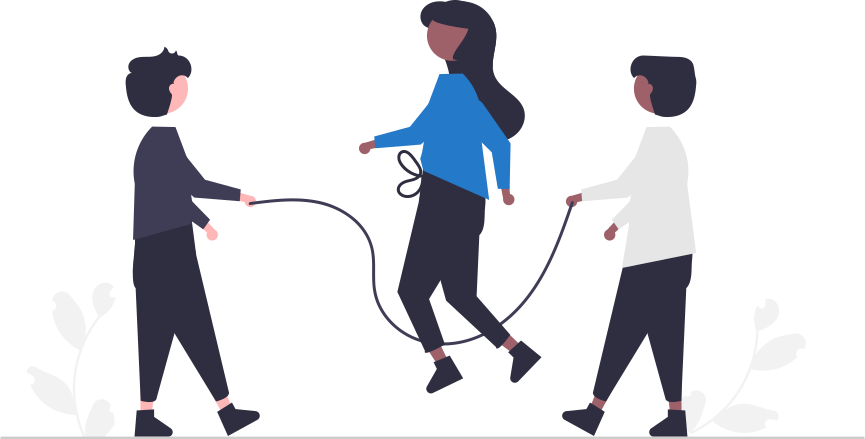
Inclusive games for kids — sometimes searched as inclusive children’s games — are games a mixed group can play without the child who is late to talk, clumsy, autistic or tired being the one who is always “it,” always last, or always sitting out. You do not need a catalogue of special-needs toys. You need one rule change and a way to join that does not depend on speed, speech or winning.
The full filterable library is on our games and exercises page. This page is the idea underneath it: what “inclusive” actually means at home, in a classroom, and at a family gathering.
What makes a children’s game inclusive?
- More than one way to join. Pointing counts. A card counts. A look counts. A spoken word is allowed, not required.
- The goal is not speed. First-to-finish games exclude the child whose motor skills or processing are slower.
- Turns are short and visible. A token, a name card, a “your turn” hand on the shoulder.
- Stopping is allowed. A child who can leave and come back will last longer than a child trapped in the circle.
- The materials are already in the house. Cups, a ball of socks, a dupatta, a picture book. Bought toys are optional.
If a game only works when everyone is the same age, the same speed and the same talker, it is not inclusive. It is a race with extra children in the way.
Inclusive children’s games you can start tonight
1. Roll and name
Sit on the floor. Roll a ball or a pair of socks. Whoever receives it names the object in their hand, or points to a picture, or makes the sound. A child with few words can hand the ball back as their turn. Speech sits underneath: speech activities at home.
2. First-then tower
One block, then a chosen toy. The “game” is the wait, not the architecture. Useful for autism and ADHD. First-then.
3. Copy me, then you pick
You clap twice. They copy. Then they choose the next move — jump, spin, animal walk. Movement seekers get the crash; quieter children pick a small move. Gross vs fine: gross motor vs fine motor.
4. Picture hunt
Two pictures. “Find the cup.” A child who cannot say “cup” can still fetch it. That is language. Receptive vs expressive.
5. Stop-and-go with a song
Music on, freeze. A child who cannot freeze can sit on a cushion as their freeze. Inclusive is a different success line, not a different song.
Ten minutes, following their lead, beats a planned hour they did not choose. Filter the full list by skill on games & exercises.
Classroom and party versions
A teacher can keep the same game and change the demand: one child names, one points, one hands the card. That is the special-needs curriculum idea — same activity, different expectation. Special needs curriculum, classroom support.
At a birthday, a child who cannot cope with musical chairs can be the DJ for one round, or hold the token that chooses the next game. Sitting out as punishment is not inclusion.
More inclusive children’s games (still no special kit)
6. Choice board snack
Two pictures. They point, you give. That is requesting. A child with no words still plays. Teaching a child to make requests.
7. Pass the clap
Clap once, pass. A child who cannot clap can tap the table or hold a card. Turns stay short. Social skill underneath: social skills at home.
8. Heavy-work race that is not a race
Carry a cushion to a hoop. Everyone finishes. Speed is banned. Movement seekers get the crash without losing. Crashing and climbing.
9. Story with a job
One child turns the page, one points to the dog, one makes the sound. Same book, three ways in. Language: reading to build language.
10. “Your turn” token
A spoon, a stone, a card. Whoever holds it goes. Visible turns beat shouted names in a noisy room.
Developmental games, free play, and speech games
Parents also search developmental games, free play activities, and activities for speech and language. Developmental games are ordinary play aimed at one skill — a turn, a word, a wait — not a worksheet dressed as fun. Free play still teaches if an adult is available to comment, not quiz. Speech-and-language games are on easy speech activities at home and the filterable games library.
Filter by what they can do now, not by birthday. A four-year-old who plays like a two-year-old needs two-year-old success, not a “4+” box. That is the same idea as a special needs curriculum: same activity, different expectation.
When a child will not join
Stand near, do the interesting bit yourself, leave a pause. Do not pull them in. A child who can watch and then take one turn has joined. A child forced into the circle learns that play is a trap. If they cannot watch, cannot take a turn, and cannot request after months of this, that is assessment, not a better toy.
When play is not enough
If they cannot take a turn, cannot look, cannot request, or play has stayed the same for months, that is a developmental assessment, not a new game. A consultation is Rs 1,500 and lasts up to 50 minutes. Social-skills work: social skills. Home programs: home programs.
Frequently asked questions
What are inclusive games for kids?
Games a mixed group can play without the child who talks less, moves differently or tires faster always sitting out. More than one way to join, short visible turns, success that is not speed, and materials you already have.
What are inclusive children’s games at home?
Ordinary play with one rule changed: pointing counts, a look counts, a freeze can be sitting on a cushion. Ten minutes following the child’s lead does more than a long session they did not choose.
Do I need special-needs toys?
No. Cups, socks, a dupatta, a picture book and a ball are enough. Bought toys are optional. Your face and a pause are the active ingredient.
My child is four but plays like a two-year-old. Which games?
Filter by what they can do now, not by birthday. Success keeps them playing. Our games library is tagged by skill and stage.
Can a teacher use these in a mixed class?
Yes. Same activity, different expectation: one names, one points, one hands a card. That is how a special-needs curriculum runs in an ordinary classroom.
What are developmental games?
Ordinary play aimed at one skill — a turn, a word, a wait — not a worksheet dressed as fun. Filter by what the child can do now, not by the age on the box. The games library is tagged by skill and stage.
When is play not enough?
When they cannot take a turn, cannot request, or play has not changed for months. Then a developmental assessment is the next step, not another game. A consultation is Rs 1,500 and lasts up to 50 minutes.