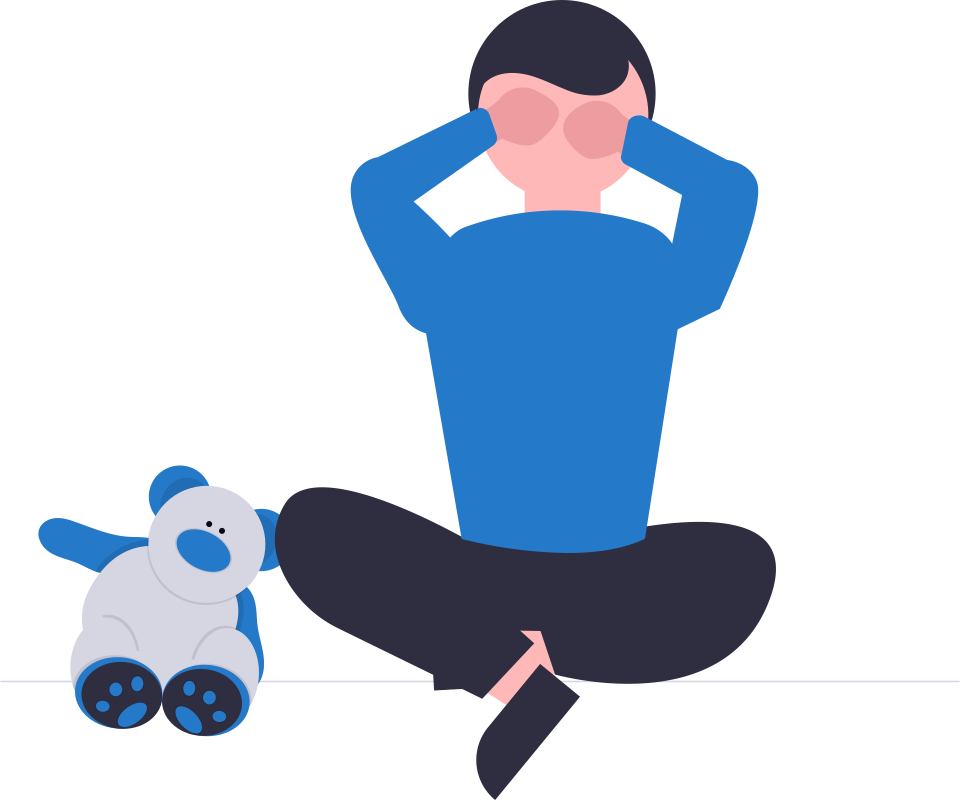
If your child talks non-stop at home and cannot say a single word at school, that pattern usually has a name: selective mutism. It is an anxiety response, not defiance, not rudeness, and not shyness that will quietly wear off — the words are there, but in certain places your child’s body treats speaking as danger and freezes them.
Parents often arrive at our centre carrying two years of “he’s just shy” and a teacher who has never heard their child’s voice. Below: what selective mutism is, how to tell it apart from shyness and from a genuine speech and language therapy problem, what to change tomorrow morning, what to ask school for, and when we would send you to a doctor first.
What is selective mutism?
Selective mutism is an anxiety-based difficulty in which a child who speaks comfortably in some places — almost always at home — is consistently unable to speak in others, most often at school. The child is not choosing silence. Anxiety stops the words before they arrive. It typically shows up between the ages of three and eight, when school demands grow.
It is not a sign of low intelligence, and it is not a problem with the speech itself. Most of these children can say every sound and every word perfectly well; you hear them do it at home every evening. The difficulty is entirely about where and with whom. Our clinical page on selective mutism sets out what the NHS and ASHA say about it and how we assess it.
Why does my child talk at home but not at school?
Home is safe and predictable, so speaking costs nothing. School is loud, watched and full of people who might turn round and look. For a child wired to be cautious, being asked a direct question in front of the whole class triggers a freeze response — the same fight, flight or freeze reaction we all have to fear. The mouth simply stops working.
That is why pressure backfires so reliably. Every “just say it”, every bribe, every extra second of a room waiting for an answer adds fear to the exact moment we need to feel safe. Children with selective mutism are often sensitive and cautious by nature, and many are bright, funny and extremely chatty in the right room. Understanding that makes it far easier to respond with patience instead of frustration.
Is it shyness, selective mutism, or a speech delay?
These three get muddled constantly, and the difference matters because each needs something different. The quick test is to ask where the words go missing: everywhere, or only in some places?
A shy child warms up. Give them a fortnight in the same classroom and you will hear a quiet voice. A child with selective mutism does not warm up — the silence holds in that same room week after week, long past the settling-in period, however kind the teacher is.
A speech or language delay looks different again: the words are thin everywhere, at home included, and understanding may lag too. If that sounds closer to your child, start with when a speech delay is genuinely a concern, and read the myths about late talking before anyone tells you to wait and see. A child can have both a delay and selective mutism, which is exactly why we look at the whole picture rather than one label.
What does selective mutism look like day to day?
Families usually describe some mix of these:
- Talks freely at home, but says nothing at school, at nursery, or with relatives they see rarely.
- Goes still and expressionless in the moment speech is expected — the frozen face is characteristic.
- Uses nodding, pointing, gestures or a whisper instead of speaking aloud.
- Talks to some family members but not others — to parents and siblings, say, but never to a grandparent.
- Becomes visibly distressed if pushed, bribed or singled out in front of others.
- The silence is consistent and has lasted well over a month, past the first weeks at a new school.
One detail parents miss: many of these children are not unhappy at school. They join in, they play, they follow everything. It is only the talking that is locked.
What can I do tomorrow morning?
Start by taking every question out of the first hour of the day. Comment instead of quizzing — say “you found your shoes” rather than “where are your shoes?” — so your child can stay in the room without owing anyone an answer. Accept a nod, a point or a whisper as a real reply. Let them see you being unbothered by silence; your calm is the treatment.
Then, gently, a few more things that help:
- Keep them going to the hard places. Do not let your child skip school or the family gathering — change what is expected of them there instead of removing it.
- Warm up before you arrive. Get to the party or the classroom early, while it is quiet and half-empty, so your child is talking to you before anyone else walks in.
- Let one person in at a time. Your child is already chatting to you in a quiet room; a single new person joins so gradually that the talking simply carries on.
- Do not make a fuss when they speak. Cheering, clapping or telling the whole family puts a spotlight on the thing that scares them. Notice it, and move on.
- Protect sleep and routine. A tired child has nothing left over for being brave.
What to stop doing today
No forcing, no bribing, no bargaining, no “say thank you or we leave”, no counting to three. It feels like firmness and it works like fear. Pressure sends a child straight back down to the rung they had just managed, and rebuilding that takes far longer than waiting would have.
What can I ask my child’s school to change?
A great deal, and mostly by doing less. Ask the teacher to stop putting direct questions to your child in front of the class, to accept a raised hand at register, and to give one warm, familiar adult the quiet job of building the relationship without asking for words. Ask that no one announces progress publicly. Then school and home follow the same ladder in the same order, one small step at a time.
This is the part most families cannot do alone, because it needs someone the school will take seriously. We write plans teachers can actually use — see how we work with schools and teachers.
What does support with us look like?
Faculty speech and language therapist Mahnoor Baloch, is a Speech & Language Therapist, and the first session is deliberately the least demanding one. We do not ask your child to speak to us. We watch: how close they will sit, whether they will play with a parent while we are in the room, whether gestures come freely, whether the face relaxes when nobody is waiting. We ask you where speech still flows — which people, which rooms, which times of day — because that map is what the plan is built on.
From there we build a ladder of small steps and rehearse each rung until it feels boring, moving up only then. Because the driver is anxiety, this often runs alongside child psychology support rather than speech work alone. We will also ask about hearing, and about whether language itself is on track, so nothing is missed underneath the silence.
What changes first is usually not the voice. It is the shoulders and the face — a child who looks less frozen, then plays more freely, then whispers to one friend, then answers the register aloud. Progress is real long before it is audible, and we say that early so families know what to look for.
When should we get help, and when would we refer you on?
Ask for help once the silence has held for more than a month in the same setting, past the settling-in weeks at a new school. Waiting rarely helps: the longer a classroom expects a child to be the silent one, the harder that role is to leave.
Some things we would send you elsewhere for first, and we will say so plainly:
- A child who used to talk everywhere and suddenly stops speaking to everyone, at home included. That is a different pattern, and it needs a doctor and a mental-health assessment before any therapy plan.
- Hearing that has never been checked. Any child who is not talking as expected deserves a hearing test — see the signs a child may need speech therapy.
- Distress that goes far beyond speaking — panic, refusal to leave the house, or sleep and eating badly affected — which needs a child mental-health service alongside us.
Nothing here is a diagnosis, and no honest therapist can promise you an outcome. What we can say is that selective mutism is well understood, and that it responds to patience far better than it responds to pressure.
“Bacha school mein baat nahi karta” — talking to us in Multan
Many families put this to us in Urdu long before they use the English name: bacha ghar par bolta hai, school mein baat nahi karta (بچہ گھر میں بولتا ہے، اسکول میں بات نہیں کرتا). If that is your sentence, you are in the right place, and none of this is your fault. We work in Urdu and English at our centre on MPS Road, Block A Model Town, Multan, near Bloomfield Hall School, Monday to Friday, 2pm to 6pm.
You do not need a diagnosis or a referral to come and talk to us. If you can, bring a short video of your child chatting happily at home — it shows us the voice the classroom has never heard, and it saves your child from being asked to perform. We will not ask them to speak to us on the first day.
If your child talks at home and goes quiet everywhere else, please know this is treatable and you are not alone with it. Contact our Multan team on WhatsApp or by phone for a warm, no-pressure first conversation.