Crossing the Midline: Why Copying and Writing Get Stuck
Written by the Inclusive Developmental and Therapy Center therapy team — our Speech & Language Therapist, psychology and ABA staff. Clinical reviewer for this site: Dr Muhammad Suffyan, MB BS (GMC 8023727) · Updated August 2026; this page has changed since our last clinical review.
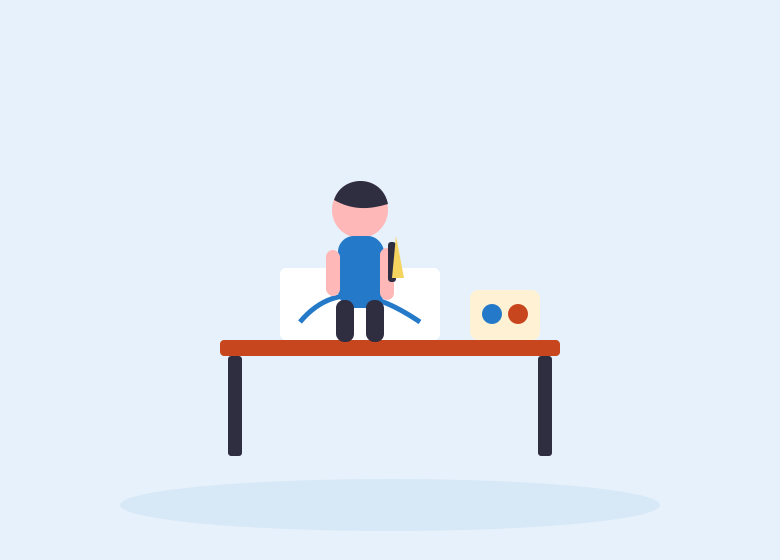
She writes the right half of the page and then stops, or turns the book sideways, or stands up to reach the left margin. He copies from the board until the teacher writes on the other side, then the line falls apart. At home they colour only the near half of a picture. Relatives say they are careless. The body is often doing something more specific: avoiding the invisible line down the middle.
Crossing the midline means using one hand, foot or eyes on the other side of the body — reaching the right hand across to the left shoe, tracking a line of print from far left to far right without a break, drawing a stroke that starts on one side and finishes on the other. It sounds small. It is one of the quiet skills that writing, copying and reading all borrow.
We do not diagnose a “midline disorder.” That is not a label we use. We watch whether the child will cross, what they do instead, and whether play can ask the body to try. We are not licensed occupational therapists. This is motor practice. A medical or neurological picture needs a different door. Motor and daily skills.
What crossing the midline actually is
Imagine a zip down the front of the shirt. Reaching across that zip with the opposite hand is crossing the midline. So is drawing a big sideways 8 in the air. So is reading a line of English from the left margin without the head snapping back to the middle halfway along. So is putting the right arm into the left sleeve first when the shirt is in the lap.
Young children often work one side at a time. That is ordinary. By the school years, most children can reach across without thinking. When they cannot, they invent workarounds that look like habits:
- Switching the pencil to the other hand when they reach the far side of the page
- Turning the paper or the whole body so the writing stays on the “near” side
- Leaving a wide empty margin on one side
- Using only the right half of a workbook, or crowding everything into a corner
- Watching the teacher with the whole trunk, not the eyes, when she moves across the board
A workaround is clever. It is also tiring, and it breaks down when the task is fast — which is most of school.
Why copying and writing suffer
Copying from the board is a midline task wearing a literacy costume. The eyes have to travel, the head has to stay reasonably still, the writing hand has to keep going when the letters sit on the far side of the page, and the other hand has to hold the book. A child who will not cross stops, loses the place, starts the line again, and is marked as slow or inattentive.
Writing a sentence is the same problem at a smaller scale. A long word that starts on the left and ends on the right is a crossing. So is a number line. So is drawing a square. So is cutting along a line that runs across the page. The child who “can do it at home” on a small sticky note may fall apart on a full copybook because the distance is the thing.
If the board is the crisis, read copying from the board next — vision, working memory and seating sit on top of this. If the fingers are the crisis, pencil grasp and handwriting. Midline is the bit in between: the body agreeing to go there.
What it looks like at the table
Watch one piece of homework without commenting. Notice:
- Does the other hand hold the page, or is it in the lap?
- Do they rotate the book as the line moves across?
- Do they lift the pencil in the middle of a letter that should be one stroke?
- When something falls on the far side of the table, do they reach across or walk around?
- In colouring, is one half of the picture ignored?
One of those on a tired Thursday is nothing. A pattern, most days, with copying and writing both suffering, is worth taking seriously as a motor question rather than a motivation one. Sitting matters too: a wobbly trunk will not send an arm across. Feet on the floor, table at elbow height. The handwriting page covers the chair. This page covers the reach.
Games that ask the body to cross
You do not need a worksheet called “midline.” You need play that makes crossing the interesting thing to do. Short, most days, and stop while it is still fun.
- Huge sideways 8s on a wall, a steamed bathroom mirror, or in the air with a scarf — both hands, then one, then the other. The eyes follow.
- Passing a ball or a cushion from the right hand to the left across the front of the body, not around the back.
- Stickers or coins on the left side of the table, picked up with the right hand, and the reverse. Sit on your hands-that-you-are-not-using so the “near” hand cannot cheat.
- Drawing a rainbow or a long road across a big sheet on the floor, kneeling, one hand, all the way over.
- Dressing games: putting the “wrong” arm in first on purpose, or taking off socks with the opposite hand. Ordinary dressing is full of crossing.
- Twister-style right-hand-on-left-spot, or hopping to a mark on the other side of a chalk line in the courtyard.
- Bat and balloon — keep a balloon up using one hand only, moving the feet so the hand still has to cross.
If they refuse to cross even in play, shrink it. A tiny reach across a notebook is still a reach. Shame (“use the proper hand”) freezes the pattern you are trying to loosen.
What is not a game
Do not sit a tired Class 3 child down for “midline exercises” after a full day of copying. That is how you get tears and no learning. The games above belong in the ten minutes before homework, or on a Saturday on the floor, not as a second homework.
Do not hold the chin and force the head to stay still while they track. Tracking can be a vision question. If they lose their place, skip lines, or hold the book very close, book an eye test. A squint or a lazy eye will look like a midline problem from the outside. Squint and lazy eye. We do not test eyes here.
Do not decide they are “not trying” because they can catch a ball in the park. Park play is often on one side. The copybook is the test they are actually failing.
Midline, sitting, and the other hand
The helper hand — the one that holds the paper — is half of writing and most of cutting. A child whose other hand is dead on the table is making the writing hand do two jobs. Ask that helper hand to hold the book, pin the paper, turn the page. It is a cheap instruction and it quietly asks the trunk to stay facing forward while one arm works across.
Crossing also shows up in sport and in the bicycle. A child who will not reach across may look clumsy in games, not only on paper. If falling, catching and buttons are all hard, the wider pattern may be coordination rather than midline alone. Clumsy child and DCD, learning to ride a bike, gross vs fine motor.
When it is more than a habit
Ask for a look if crossing is avoided in play as well as on paper, if copying from the board is a daily disaster, if one side of every page is empty, or if the rest of motor life is also effortful. A skill that is getting worse needs a doctor, not a game.
We will not name this as a disease. We will tell you whether we think the body needs practice, whether the eyes need a test, and whether school should change seating and how much is copied at once. That last one is a classroom ask, not a diagnosis. Classroom help is written for speech; the same spirit — seating, less copying, time to start — applies here. Classroom support, letter to school.
School: one thing to ask this week
Sit them where they can see the board without twisting away from their writing hand. Reduce how much must be copied in one go: one line, pause, then the next. Let them start the writing before the board is wiped. Extra time to start is often more useful than extra time at the end. Give the teacher one sentence: “He loses the line when he has to look left and write right; pausing after each line helps.” That is usable on Monday.
Akasha’s classroom-skills hours practise sitting, looking, and a short copy without turning it into a character lecture. Classroom skills with Akasha.
Where we fit
We watch reach, copy, cut, and play. We pick one game and one classroom sentence. We do not diagnose, and we do not call this occupational therapy. Contact the owner first. School-readiness hours with Akasha are where sitting and a short table task get practised when that is the next step.
A consultation is Rs 1,500 and lasts up to 50 minutes, Monday to Friday, 2pm to 6pm, in Model Town or online. Book.
Frequently asked questions
What does crossing the midline mean?
Using one hand, foot or the eyes on the other side of the body — reaching the right hand across to the left shoe, tracking a line of print from far left to far right, drawing a stroke that starts on one side and finishes on the other. Young children often work one side at a time. By school age, most children cross without thinking.
How does it affect writing and copying from the board?
Copying asks the eyes to travel and the writing hand to keep going when letters sit on the far side of the page. A child who avoids the middle may turn the paper, switch hands, leave one margin empty, or lose their place every time the teacher writes on the other side of the board. It looks like inattention. It is often a body problem.
What games help a child cross the midline?
Big sideways 8s on a wall or in the air, passing a ball from right hand to left across the front of the body, picking up stickers on the far side of the table with the opposite hand, drawing a rainbow across a large sheet, and ordinary dressing with the “wrong” arm first. Short, playful, and stop while it is still fun. Not as extra homework after a full school day.
Could it be their eyes instead?
Yes. Losing their place, skipping lines, or holding a book very close can be vision. A squint or lazy eye can look like a midline problem from the outside. Book an eye test. We do not test eyes here.
Is avoiding the midline a diagnosis?
Not one we use. We watch whether the child will cross, what they do instead, and whether play and seating help. We do not diagnose a “midline disorder,” and we are not licensed occupational therapists. A medical picture needs a different door.
What should I ask the teacher?
Seating so they can see the board without twisting away from the writing hand, one line of copying at a time, and extra time to start before the board is wiped. One concrete sentence beats a label: “He loses the line when he has to look left and write right; pausing after each line helps.”